Where to Buy a Toaster: Online vs. In-Store Buying Guide

Not sure where to buy a toaster? Compare online, in-store, brand website, warehouse club, and discount store options before making your purchase.

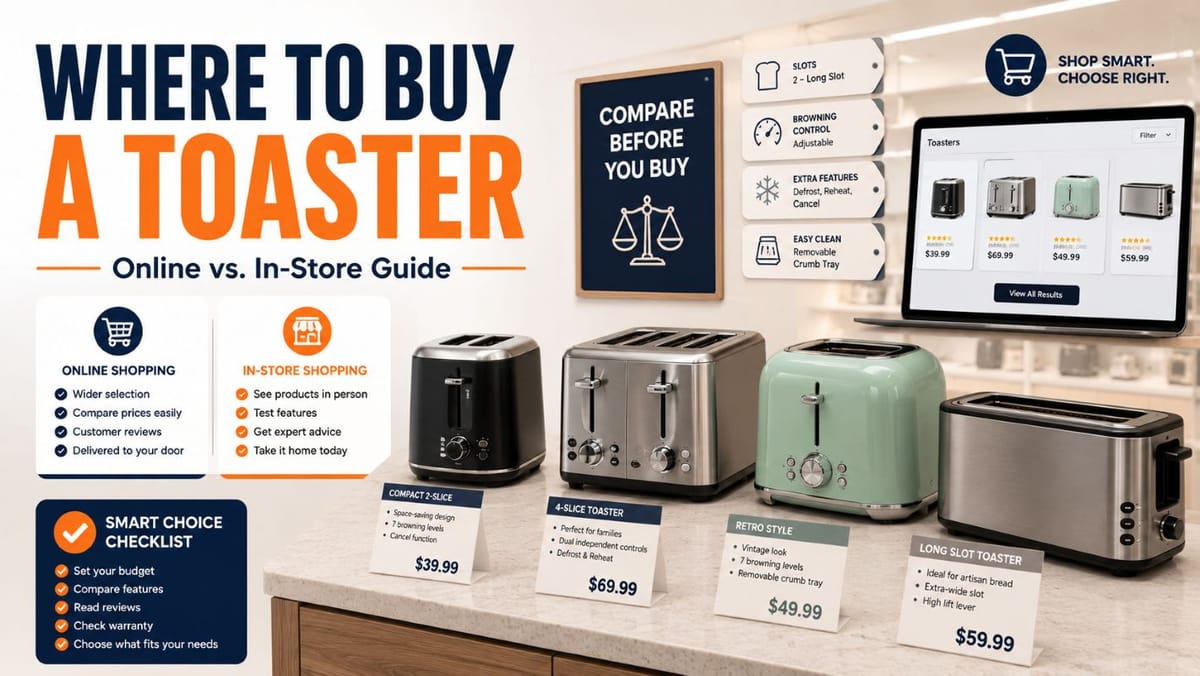
Where to Buy a Toaster: Online vs. In-Store Buying Guide
Several toaster options displayed in a retail-style kitchen showroom for a toaster buying guide.

Buying a toaster is not just about choosing the right model. It is also about choosing the right place to buy it.

Two toasters may look identical, but the buying experience can be very different depending on where you purchase them. One store may offer easier returns. Another may have better prices. A brand website may provide clearer product details. A physical store may let you see the size and finish before you bring it home.

For a small appliance like a toaster, the purchase may not feel complicated. But the channel still matters. If the toaster arrives damaged, looks larger than expected, does not fit your bread, or fails after a few uses, your buying channel can determine whether the problem is easy to solve or frustrating.

This guide explains where to buy a toaster, when online shopping makes sense, when buying in-store is better, and what to check before clicking the order button or walking to the checkout counter.

Quick Answer

The best place to buy a toaster depends on what matters most to you.

Online retailers are convenient and usually offer the widest selection. Physical stores are better if you want to see the size, finish, controls, and build quality before buying. Brand websites can be useful for checking official specifications and warranty details. Warehouse clubs may offer value bundles or simple choices, while local appliance and home stores may provide more hands-on help.

For most buyers, the best approach is to research online first, compare prices and return policies, then buy from the channel that offers the best combination of selection, reliability, delivery, and after-sale support.

Key Takeaways

  • Online shopping usually gives you the widest toaster selection.
  • In-store shopping lets you inspect size, finish, controls, and build quality.
  • Brand websites are useful for official specifications and warranty information.
  • Return policy matters more than many buyers realize.
  • Check shipping costs, delivery time, and restocking rules before buying.
  • Avoid unknown sellers with unusually low prices or unclear return terms.
  • Buying from a trusted retailer is often worth slightly more than saving a few dollars.
  • For gifts or urgent needs, local stores may be the better option.
  • For product research, compare several channels before deciding.
  • The safest purchase is usually the one with clear pricing, clear policies, and reliable support.

Why the Buying Channel Matters

A toaster is a relatively simple appliance, but the buying channel can still affect your overall experience.

A good buying channel helps you answer practical questions:

  • Is the product new, open-box, refurbished, or used?
  • Can you return it if it does not fit your kitchen?
  • Who handles warranty support?
  • Is shipping free or extra?
  • What happens if the toaster arrives damaged?
  • Are reviews tied to the exact model?
  • Are replacement parts or manuals easy to find?
  • Can you compare similar models easily?

These details are easy to overlook when the price looks attractive. But they matter when something goes wrong.

A toaster may be inexpensive compared with a refrigerator or oven, but it is still an appliance that uses heat. You want a product that is properly described, safely packaged, easy to return if needed, and supported by a seller you can contact.

Buying a Toaster Online

Online shopping is often the easiest way to buy a toaster. It gives you access to more models, more colors, more sizes, and more user reviews than most physical stores can display.

This is especially helpful if you are comparing:

  • 2-slice vs. 4-slice models
  • Wide-slot toasters
  • Long-slot toasters
  • Retro designs
  • Stainless steel finishes
  • Compact models
  • Toasters with bagel or frozen settings
  • Higher-end models
  • Budget options

Online shopping also makes it easier to compare prices across multiple sellers. You can check product photos, dimensions, feature lists, user reviews, and sometimes manuals before buying.

The main downside is that you cannot physically inspect the toaster. You cannot feel the lever, test the buttons, judge the real countertop footprint, or see the finish under your kitchen lighting.

That is why online buying works best when you already know what features you want and are comfortable reading specifications carefully.

If you are still deciding what features matter most, start with our guide on what to look for when buying a toaster.

Buying a Toaster In-Store

Buying in-store can be a better choice if you want to see the toaster before purchasing.

This matters more than many people expect. A toaster may look compact in photos but feel large on the counter. Stainless steel may look different in person. A lever may feel flimsy. A knob may feel loose. A 4-slice model may take up more space than expected.

In-store shopping lets you check:

  • Actual size
  • Exterior finish
  • Slot width
  • Control layout
  • Lever feel
  • Button placement
  • Weight
  • Cord position
  • Overall build quality

You may not be able to test the toaster with bread, but you can still learn a lot by looking at it closely.

In-store shopping is also useful when you need a toaster immediately. If your current toaster stopped working and you need a replacement for tomorrow’s breakfast, a local store may be the simplest option.

The downside is selection. A physical store may carry only a few models, and the available colors or features may be limited.

Buying From a Brand Website

A brand’s official website is one of the best places to verify product details, even if you do not buy there.

Brand websites often provide:

  • Official model numbers
  • Dimensions
  • Feature descriptions
  • User manuals
  • Warranty information
  • Product registration details
  • Accessory information
  • Safety instructions

This can be especially useful when multiple models look similar. A retailer listing may shorten or simplify the description, while the brand website may show the exact difference between versions.

Buying directly from a brand can also make sense if you want a specific color, newer model, or official bundle that is not widely available elsewhere.

However, brand websites are not always the cheapest option. Return policies and shipping terms may also differ from large retailers. Before buying, compare the total cost and after-sale support.

Buying From Big-Box Retailers

Large general retailers are popular places to buy toasters because they usually offer a balance of selection, convenience, and return support.

They may carry budget models, mid-range models, and premium options. Many also allow you to compare online inventory with local pickup availability.

This channel is useful if you want:

  • Easy returns
  • Fast shipping or pickup
  • Familiar checkout process
  • A mix of brands
  • Customer reviews
  • Seasonal discounts
  • Basic appliance selection

For many buyers, this is the most practical option. You can research online, check local availability, and choose between delivery or pickup.

The main caution is to pay attention to the seller. Some large retail websites include third-party marketplace sellers. If the listing is not sold directly by the retailer, review the seller information, return process, and shipping terms carefully.

Buying From Home Goods or Kitchen Stores

Home goods and kitchen-focused stores may be a good place to buy a toaster if design and kitchen style matter to you.

These stores often focus on appliances that look good on the counter. You may find retro colors, premium finishes, compact designs, or coordinated kitchen collections.

This can be helpful if you care about:

  • Kitchen aesthetics
  • Matching appliances
  • Gift purchases
  • Better packaging
  • Display models
  • Design-focused brands

The price may be higher than at general retailers, but the shopping experience may be more curated.

This channel works well for buyers who want a toaster that looks as good as it performs.

Buying From Warehouse Clubs

Warehouse clubs can be a good option if you want value and simplicity.

They may not carry many toaster models, but the options they do carry are often chosen for broad appeal. You might find a 4-slice toaster, a stainless steel model, or a bundle with a strong value proposition.

Warehouse clubs can be useful for:

  • Families
  • Bulk shoppers
  • Value-focused buyers
  • Simple model selection
  • Gift purchases
  • Buyers who trust the club’s return process

The downside is limited choice. If you want a very specific size, color, or feature set, a warehouse club may not have it.

This is a good channel when the available model already matches your needs.

Buying From Discount Stores

Discount stores can be attractive when price is the top priority.

You may find basic toasters at low prices, especially simple 2-slice models. For a dorm, temporary apartment, guest space, or low-use kitchen, this may be enough.

However, low price should not be the only factor.

Check:

  • Build quality
  • Slot size
  • Return policy
  • Safety labeling
  • Warranty information
  • Reviews if available
  • Whether the model is current or discontinued

A very cheap toaster may be fine for light use, but if you toast every morning, durability and cleaning design may matter more than saving a few dollars.

Buying Open-Box, Refurbished, or Used Toasters

Open-box, refurbished, or used appliances can save money, but toasters require extra caution.

A toaster is a heat-producing appliance that comes into contact with food particles. Unlike some electronics, it can collect crumbs, grease, residue, and odors from previous use.

Open-box may be acceptable if the product is unused, complete, and returnable. Refurbished may be acceptable if it comes from a reputable seller with a clear warranty. Used toasters are less appealing unless you can inspect them carefully and trust the source.

Before buying open-box or refurbished, check:

  • Is it unused or previously used?
  • Are all parts included?
  • Is the crumb tray clean and intact?
  • Is the cord undamaged?
  • Is there a warranty?
  • Can you return it?
  • Is the discount large enough to justify the risk?

For most people, a new toaster from a reliable seller is simpler and safer.

Online Marketplace Sellers: What to Watch For

Online marketplaces can be useful because they offer many options in one place. But they also require more attention.

Not every listing is sold by the same type of seller. Some are sold by the platform itself. Others are sold by third-party sellers. Some are fulfilled by a major platform but still sold by an outside seller.

Before buying, check:

  • Who is the seller?
  • Is the model number clear?
  • Is the product new?
  • Are reviews for the exact product?
  • Is the return policy clear?
  • Is the price unusually low?
  • Are shipping dates realistic?
  • Are warranty terms included?

Be careful with listings that use vague descriptions, copied photos, very low prices, or unclear return instructions.

A toaster does not need to come from the cheapest seller. It should come from a reliable seller.

Return Policy: One of the Most Important Details

Return policy is one of the most important things to check before buying a toaster.

A toaster may look right online but feel wrong in your kitchen. The slots may be too narrow. The controls may feel cheap. The browning may not match your expectations. The appliance may arrive damaged.

A clear return policy gives you room to solve these problems.

Before buying, check:

  • How many days do you have to return it?
  • Can you return it after opening the box?
  • Does it need original packaging?
  • Who pays return shipping?
  • Is there a restocking fee?
  • Can it be returned in-store?
  • Does the policy differ for third-party sellers?
  • How are refunds issued?

Do not assume every retailer handles returns the same way. Policies can change, and marketplace sellers may have different terms from the main retailer.

Warranty and Support

A toaster warranty is usually less exciting than the product features, but it still matters.

Warranty terms can help if the toaster fails early due to a defect. They may also indicate how much confidence the brand has in the product.

Look for:

  • Warranty length
  • What is covered
  • What is excluded
  • Whether proof of purchase is required
  • How to contact support
  • Whether shipping is required for service
  • Whether registration is needed

Keep your receipt or order confirmation. If the toaster fails, proof of purchase may be necessary.

If durability is one of your main concerns, our guide on how long toasters last explains typical lifespan factors and replacement signs.

Price Comparison: Look at Total Cost

When comparing toaster prices, do not look only at the sticker price.

The real cost may include:

  • Shipping
  • Taxes
  • Return shipping
  • Restocking fees
  • Membership requirements
  • Extended warranties
  • Accessories
  • Delivery speed

A toaster that appears cheaper may not be the best deal if shipping is expensive or returns are difficult.

Also consider timing. Toasters often go on sale during major shopping periods, holiday promotions, back-to-school season, and kitchen appliance events. If your need is not urgent, comparing prices over time may help.

But do not wait forever to save a small amount. For a daily appliance, convenience and reliability can be worth more than a minor discount.

Should You Buy the Cheapest Toaster?

Sometimes a cheap toaster is enough.

If you only toast simple sandwich bread occasionally, a basic model may work fine. You may not need premium finishes, digital displays, or multiple presets.

However, the cheapest toaster is not always the best value.

Pay a little more if you need:

  • Wider slots
  • Better browning consistency
  • A 4-slice design
  • Easier cleaning
  • Better build quality
  • A high-lift lever
  • Bagel or frozen settings
  • Stronger return support

The goal is not to buy the most expensive toaster. The goal is to avoid buying the wrong toaster.

Best Channel by Buyer Type

Different buyers should prioritize different channels.

Best for Fast Replacement

A local retail store is often best if you need a toaster immediately.

You can buy it the same day, inspect the box, and avoid waiting for shipping.

Best for Wide Selection

Online retailers are usually best for selection.

This is the best route if you want a specific color, slot size, design, or feature combination.

Best for Product Details

Brand websites are best for official information.

Use them to confirm dimensions, manuals, warranty terms, and model differences.

Best for Value

Warehouse clubs and large retailers can be good for value, especially when the model fits your needs.

Best for Design

Home goods and kitchen specialty stores may be best if appearance and countertop style matter.

Best for Budget Buyers

Discount stores and sale sections can work if you are buying a simple toaster for light use.

Red Flags to Avoid

Avoid buying a toaster from a seller or listing if you notice:

  • No clear return policy
  • No recognizable seller information
  • Unclear model number
  • Suspiciously low price
  • Poor product photos
  • Reviews that do not match the item
  • No warranty information
  • Long or uncertain shipping times
  • Vague product condition
  • Pressure tactics or countdown claims
  • No contact information

A toaster is not a product where you need to take a gamble. There are usually many reliable options available.

What to Check Before You Buy

Before finalizing the purchase, run through this checklist:

  • Does it fit your counter space?
  • Is it 2-slice or 4-slice?
  • Are the slots wide enough?
  • Does it have a removable crumb tray?
  • Does it have the settings you need?
  • Is the return policy clear?
  • Is the seller reliable?
  • Is the warranty information available?
  • Are shipping costs reasonable?
  • Are reviews tied to the exact model?
  • Does the finish match your kitchen?
  • Is the total cost still reasonable?

This simple checklist can prevent most common buying regrets.

FAQ

Is it better to buy a toaster online or in-store?

Online is better for selection and comparison shopping. In-store is better if you want to see the size, finish, and controls before buying. The best choice depends on your priorities.

Where is the best place to buy a toaster?

The best place is a reliable seller with clear product information, fair pricing, reasonable shipping, and a return policy you understand. That may be an online retailer, local store, brand website, warehouse club, or home goods store.

Should I buy a toaster from the brand website?

A brand website is useful for official specifications and warranty information. It can also be a good place to buy specific colors or newer models, but compare price and return terms before ordering.

Are cheap toasters worth buying?

Cheap toasters can be worth buying for light use or simple sandwich bread. If you toast daily, need wide slots, or care about durability, spending a little more may be worthwhile.

Is it safe to buy a used toaster?

Used toasters require caution because they may contain crumbs, grease, odors, or hidden damage. For most buyers, a new toaster or clearly unused open-box model is a safer choice.

What should I check before buying a toaster online?

Check the seller, model number, dimensions, slot size, reviews, return policy, warranty, shipping cost, and product condition.

Should I buy an extended warranty for a toaster?

For many basic toasters, an extended warranty may not be necessary. For higher-priced models, compare the warranty cost with the product price and the manufacturer’s standard coverage.

Can I return a toaster after using it?

That depends on the seller’s policy. Always check return rules before buying, especially for opened small appliances.

Are marketplace sellers reliable?

Some are reliable, but others may be harder to evaluate. Check who the seller is, whether returns are clear, and whether the product is new and authentic.

What is the safest way to buy a toaster?

Buy from a reliable seller, confirm the product details, read the return policy, keep your receipt, and avoid listings that look unclear or too good to be true.

Final Verdict

Where you buy a toaster matters almost as much as which toaster you buy.

Online retailers are best for selection and comparison. Physical stores are best for seeing the appliance before purchase. Brand websites are best for official information. Warehouse clubs and large retailers can offer good value. Specialty stores may be better for design-focused buyers.

The best buying channel is the one that gives you the right toaster with the least uncertainty. That means clear specifications, reliable seller information, fair pricing, reasonable delivery, and a return policy that protects you if the toaster is not right for your kitchen.

A toaster is a small appliance, but it is one you may use every day. Buy from a place that makes the decision easier, not harder.

Editorial Note: Appliance Research Hub creates independent appliance guides, comparisons, and research-based articles using publicly available product information, manufacturer instructions, consumer safety considerations, and editorial analysis. We aim to help readers make informed household appliance decisions, but appliance features, prices, warranties, and retailer policies may vary. Always check current seller terms and follow the manual for your specific toaster.