How Much Electricity Does a Toaster Use?
Learn how much electricity a toaster uses, average toaster wattage, estimated operating costs, and whether daily toaster use has a meaningful impact on your electric bill.

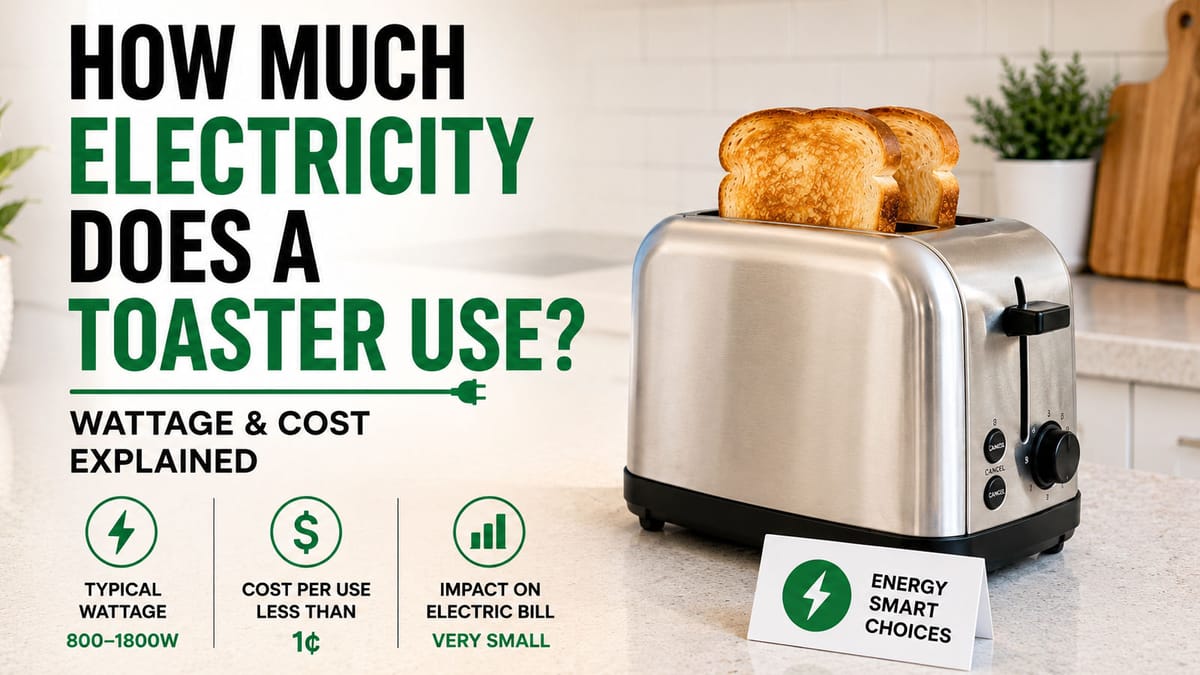
The short answer is: almost nothing, by appliance standards. Most households spend under $7 a year running a toaster daily, which puts it at the bottom of the kitchen appliance cost list — far below the coffee maker, the microwave, and certainly the oven.
That surprises people because toasters draw a lot of watts. But wattage only tells half the story. The other half is time.
The math is simpler than it looks
A standard 2-slice toaster uses somewhere between 800 and 1,200 watts while it's running. A 4-slice model typically falls in the 1,200–1,500 watt range. Call it 1,100 watts as a reasonable middle estimate for the toaster on most kitchen counters.
Electricity bills are calculated in kilowatt-hours — that's one kilowatt running for one full hour. The formula is straightforward: multiply watts by hours of use, then divide by 1,000.
A toasting cycle runs about 2 to 4 minutes. At 1,100 watts for 3 minutes, that's roughly 0.055 kilowatt-hours per cycle. At a typical US residential rate of around $0.16 per kWh, one round of toast costs about 0.9 cents.
Two slices every morning for a year: roughly $6.50.
That's about what you'd spend on a single latte.
Why wattage feels misleading
It's easy to look at a 1,200-watt toaster and think "that's as much as my hairdryer" — which is true, but a hairdryer runs for 10 minutes while a toaster runs for 3. A conventional oven might draw 2,500 watts or more, but it also preheats for 15 minutes before you put anything in it. Those 15 minutes alone cost more than a week of daily toasting.
The comparison that often surprises people: your oven preheating to 375°F for 15 minutes consumes roughly 10 times more electricity than making two pieces of toast. If you're trying to save on your electric bill, the toaster is not the place to look.
| Appliance | Typical wattage | Typical use time | Cost per session (est.) |
|---|---|---|---|
| Pop-up toaster | 800–1,500 W | 3 minutes | ~$0.01 |
| Coffee maker | 800–1,400 W | 10 minutes | ~$0.02 |
| Microwave | 600–1,200 W | 5 minutes | ~$0.01 |
| Electric oven (preheat only) | 2,000–3,000 W | 15 minutes | ~$0.09 |
| Clothes dryer | 4,000–6,000 W | 45 minutes | ~$0.55 |
Estimates based on $0.16/kWh. Your rate may differ.
What actually affects your toaster's energy use
Browning level makes a small difference — darker toast settings run longer cycles. But the range is a matter of seconds, not minutes, so the cost difference is negligible.
4-slice vs. 2-slice also barely moves the needle. A 4-slice toaster uses more watts per cycle, but if you're toasting four slices anyway, you're making one cycle instead of two. The total energy use is similar.
Toaster ovens are the real outlier here. They're often lumped in with pop-up toasters, but they work more like small ovens — larger heating elements, longer cycles, sometimes 20-30 minutes of sustained heat. If you're using a toaster oven as your primary toasting appliance, your energy use is meaningfully higher, though still modest compared with a full-size oven.
The standby question
One thing you can safely stop worrying about: unplugging your toaster to save energy. A standard pop-up toaster draws no measurable standby power when it's idle. The lever is a mechanical switch — there's no circuit active when the toaster is just sitting there. Unplugging it is fine for peace of mind or safety habits, but it won't show up on your electric bill.
If you're evaluating toasters more broadly — reliability, durability, which models actually last — our best toasters of 2026 guide covers what owner-review patterns reveal about the brands worth trusting.